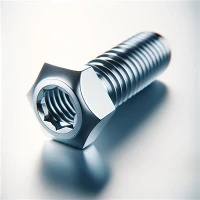
Slotted Truss Head Machine Screws
Our Slotted Truss Head Machine Screws are manufactured by the cold heading and hot forming technologies in nominal diameters ranging from 1/8"- 3" (M3 – M80). We offer fasteners in both USCS/Imperial and metric sizes.

- Product Introduction
Description
There are two major varieties of screws- machine screws and manual screws. The major difference between them is that machine screws are tightened by an electrical drill machine, whereas manual screws are fitted manually. Due to this, machine screws are better at fastening components than manual screws.
According to sizes, materials, models, and configurations, there are various kinds of machine screws available in the market, like stainless steel (SS) machine screws, brass machine screws, Phillips head machine screws, tamper-resistant machine screws, plated machine screws, Torx heads, slotted or flat-head machine screws, hex-head machine screws, Fillister machine screws, and Pan-head machine screws.
Machine screws are used in making modular kitchens, furniture, construction equipment, etc. They are designed to be inserted into a pre-cut or pre-threaded hole. Machine screws consist of a head and a fully threaded shank. The exterior of this shank allows the machine screw to be inserted in the tapped hole and join the two ends.
Our Slotted Truss Head Machine Screws are manufactured by cold heading and hot forming technologies in nominal diameters ranging from 1/8"- 3" (M3 – M80). We offer fasteners in both USCS/Imperial and metric sizes.
Features
1. Truss Head design: Slotted Truss Head Machine Screws feature a Truss Head design, providing a larger contact area and better fastening strength.
2. Single slot design: The product is equipped with a single slot, making it easy to use with a standard flat-head screwdriver for installation and removal.
3. Multiple sizes and specifications: The product offers a variety of sizes and specifications to accommodate different application scenarios and thread requirements.
4. High-strength material: These are typically made from high-strength steel or stainless steel, providing excellent tensile strength and corrosion resistance.
5. Wide range of applications: This type of screw is widely used in mechanical engineering, electronics, furniture manufacturing, and other fields for securing and connecting various components.
Specifications
|
|
||||||||||
| Dimensions of Slotted Truss Head Machine Screws | ||||||||||
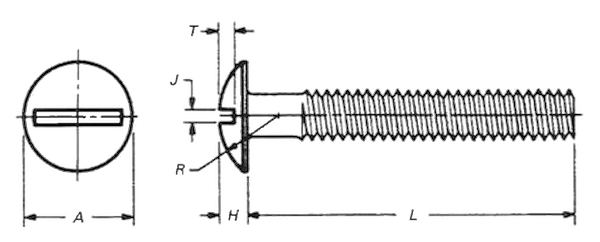
| Nominal Size or Basic Screw Diameter | A | H | R | J | T | |||||
| Head Diameter | Head Height | Head Radius | Slot Width | Slot Depth | ||||||
| Max. | Min. | Max. | Min. | Max. | Max. | Min. | Max. | Min. | ||
| 5 | 0.1250 | 0.289 | 0.272 | 0.078 | 0.066 | 0.191 | 0.043 | 0.035 | 0.045 | 0.034 |
| 6 | 0.1380 | 0.321 | 0.303 | 0.086 | 0.074 | 0.211 | 0.048 | 0.039 | 0.050 | 0.037 |
| 8 | 0.1640 | 0.384 | 0.364 | 0.102 | 0.088 | 0.254 | 0.054 | 0.045 | 0.058 | 0.045 |
| 10 | 0.1900 | 0.448 | 0.425 | 0.118 | 0.103 | 0.283 | 0.060 | 0.050 | 0.068 | 0.053 |
| 12 | 0.2160 | 0.511 | 0.487 | 0.134 | 0.118 | 0.336 | 0.067 | 0.056 | 0.077 | 0.061 |
| 1/4 | 0.2500 | 0.573 | 0.546 | 0.150 | 0.133 | 0.375 | 0.075 | 0.064 | 0.087 | 0.070 |
| 5/16 | 0.3125 | 0.698 | 0.666 | 0.183 | 0.162 | 0.457 | 0.084 | 0.072 | 0.106 | 0.085 |
| 3/8 | 0.3750 | 0.823 | 0.787 | 0.215 | 0.191 | 0.538 | 0.094 | 0.081 | 0.124 | 0.100 |
| 7/16 | 0.4375 | 0.948 | 0.907 | 0.248 | 0.221 | 0.619 | 0.094 | 0.081 | 0.142 | 0.116 |
| 1/2 | 0.5000 | 1.073 | 1.028 | 0.280 | 0.250 | 0.701 | 0.106 | 0.091 | 0.161 | 0.131 |
| 9/16 | 0.5625 | 1.198 | 1.149 | 0.312 | 0.279 | 0.783 | 0.118 | 0.102 | 0.179 | 0.146 |
| 5/8 | 0.6250 | 1.323 | 1.269 | 0.345 | 0.309 | 0.863 | 0.133 | 0.116 | 0.196 | 0.162 |
| 3/4 | 0.7500 | 1.573 | 1.511 | 0.410 | 0.368 | 1.024 | 0.149 | 0.131 | 0.234 | 0.182 |
How to Use a Machine Screw?
Institutions use a machine screw by tapping or drilling it into a pre-cut hole or nut, either manually or with a screwdriver. Machine screws are also used along with nuts; in this case, the nut will go behind the rearmost component.
They are versatile in nature and are often used to join different components and their parts. Firearms have many parts that need to be attached, and so they use small machine screws as they are easy and tight to disassemble. They are also used in jigs in machining, fixtures, dies, and electrical connections
The alternative use of machine screws is to separate and secure parts which are to be kept at a fixed distance from each other. This is achieved through a type of threaded coupling which allows machine screws to be fixed in opposing directions. The length of the coupling inserted between the two fasteners will depend on the separation distance required between the components.
What Are The Various Uses Of Machine Screws?
Machine screws are most commonly used to connect metal pieces and panels together. This is a common requirement in all types of industries, including:
Manufacturing
Production
Assembly
Industrial settings
In other words, machine screws are utilised like any other kind of screw or bolt. Some of the uses of machine screws also include:
Drilling or tapping into a pre-drilled hole or nut
Holding down or sandwiching gaskets and membranes
Used on terminal strips and for a variety of other electrical connections
Separating and securing components or panels that must be kept at a predetermined distance from one another
How is a Slotted Truss Head Machine Screw Made?
Heading
Wire is fed from a mechanical coil through a straightening machine. The straightened wire flows directly into a machine that automatically cuts the wire to length and die cuts the head of the screw into the required shape.
Cutting the Thread
Once cold-headed, the screws are automatically fed to the thread-cutting machine. The screws are then cut using one of two different techniques. In the reciprocating die method, two flat dies are used to cut the screw thread. One die is stationary while the other moves in a reciprocating manner, and the screw blank is rolled between the two. The second method of thread rolling is the planetary rotary die process, which holds the screw blank stationary while several die-cutting machines roll around the blank.
Heat Treatment
Heat treating the screws increases their overall durability. The screws are heated to a high temperature (about 900°C/1652°F) and then dipped into water. This sudden change in temperature hardens the bolt or screw material.
Coating
The type of coating is determined by the screw's use. The main concern for screws is their corrosion resistance, so a zinc-plated coating is a common choice. This process involves submerging the screw in a liquid containing zinc and applying an electric current so that the zinc bonds to the screw, forming a coating over the surface. While zinc-coated screws are fine for indoor use, for outdoor applications you'll need something stronger. That's where other options, such as galvanized zinc flake coating or ceramic coating, come in for superior corrosion resistance.
FAQs
Q: What is a slot head screw used for?
Q: How long should a machine screw be?
Q: What are the benefits of slotted screws?
Q: Why are slotted screws still used?
Q: What are machine screws used for?
Q: What is the strength of a machine screw?
Q: How is a machine screw measured?
Q: What is a slotted head screw?
Q: How to remove slotted screws?
Q: What are machine screws made of?
Hot Tags: slotted truss head machine screws, China slotted truss head machine screws manufacturers, suppliers, factory, wear resistant screws, screw diameter, screw drive gauges, socket sets, versatile screws, wholesale screws