





12 Point Flange Screws
Our 12 Point Flange Screws are manufactured by the cold heading and hot forming technologies in nominal diameters ranging from 1/8"- 3" (M3 – M80). We offer flange screws in both USCS/Imperial and metric sizes.

- Product Introduction
Description
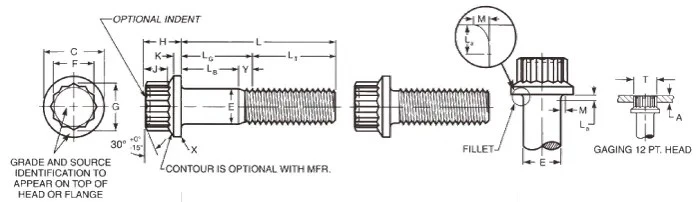
12-Point flange screws, also known as Ferry Bolts, are high-strength fasteners where the flange diameter and head thickness of the 12-Point Flange Screw are equivalent to the head dimensions of a socket head cap screw, thus permitting the 12-Point Flange Screw to be a replacement for any application that calls for a socket head cap screw. The 12-point head design means that this screw can be tightened with a 12-point socket wrench, which allows higher torques to be applied compared to a standard internal hex drive socket head cap screw. The head or wrench size is the same as the body size.
Our 12 Point Flange Screws are manufactured in nominal diameters ranging from 1/8" to 3" (M3 – M80). We offer fasteners in both USCS/Imperial and metric sizes. Our fasteners meet applicable ASTM, ANSI, ASME, SAE, API, NAS, AN, MS, NACE, ISO, DIN, and KS standards.
Features
- Twelve-point flange screws are an alternative head design for hex socket cap screws. The flange diameter and head height are designed to fit applications and counterbored holes intended for standard hex socket cap screws.
- Twelve-point flange screws are manufactured with the same thread length as socket head cap screws (2 times the diameter + 1/2" minimum guaranteed threads).
- The 12 point head design is tightened with standard twelve point socket wrenches. The 12-point design permits greater torque to be applied to the bolt and eliminates the rounding of the hex socket that occurs with standard hex sockets.
- The flange diameter and head thickness of the 12 Point Flange Bolt are equivalent to the head dimensions of a socket head cap screw. This permits the Twelve Point Flange Bolt to be a replacement for any application currently using a socket head cap screw.
- The 12 point design permits this style bolt to be tightened down with a 12 point socket wrench, allowing higher torque to be applied compared to a standard internal hex drive socket head cap screw.
- The higher strength and larger bearing area under the head of this design provide additional benefits for assemblies over standard hex head cap screws. Additionally, it is more aesthetically pleasing than standard cap hex or socket head cap screws.
Specifications
|
|
||||||||||||||||||||||
| Dimensions of 12-Point Flange Screws | ||||||||||||||||||||||
| Nominal Size or Basic Major Diameter of Thread | E | C | F | G | H | J | K | Runout of Bearing Surface FIM | M | La | Bearing Surface Juncture Radius | X | A | T | LT | Y | ||||||
| Body Diameter Min. | Flange Diameter | Width Across Flats | Width Across Corners | Head Height | Wrenching Height | Flange Thickness | Filet Extension | Fillet Length | Chamfer or Radius | Gaging Ring Thickness | Gaging Ring Diameter | Thread Length | Transition Thread Length | |||||||||
| Max. | Min. | Max. | Min. | Min. | Max. | Min. | Min. | Max. | Max. | Min. | Max. | Max. | Max. | Min. | Max. | Min. | Basic | Max. | ||||
| 1/4 | 0.2500 | 0.2435 | 0.375 | 0.365 | 0.252 | 0.244 | 0.278 | 0.260 | 0.15 | 0.058 | 0.007 | 0.014 | 0.009 | 0.087 | 0.007 | 0.020 | 0.0525 | 0.0522 | 0.2783 | 0.2780 | 1.000 | 0.25 |
| 5/16 | 0.3125 | 0.3053 | 0.469 | 0.457 | 0.315 | 0.306 | 0.348 | 0.312 | 0.18 | 0.074 | 0.008 | 0.017 | 0.012 | 0.087 | 0.009 | 0.020 | 0.06 | 0.0597 | 0.3483 | 0.3480 | 1.125 | 0.28 |
| 3/8 | 0.3750 | 0.3678 | 0.562 | 0.550 | 0.377 | 0.368 | 0.420 | 0.375 | 0.21 | 0.095 | 0.010 | 0.020 | 0.015 | 0.087 | 0.012 | 0.020 | 0.0711 | 0.0708 | 0.4203 | 0.4200 | 1.250 | 0.31 |
| 7/16 | 0.4375 | 0.4294 | 0.656 | 0.642 | 0.438 | 0.429 | 0.489 | 0.438 | 0.25 | 0.109 | 0.011 | 0.023 | 0.018 | 0.087 | 0.014 | 0.030 | 0.084 | 0.0837 | 0.4893 | 0.4890 | 1.375 | 0.36 |
| 1/2 | 0.5000 | 0.4919 | 0.750 | 0.735 | 0.502 | 0.493 | 0.562 | 0.500 | 0.29 | 0.129 | 0.013 | 0.026 | 0.020 | 0.087 | 0.016 | 0.030 | 0.0948 | 0.0945 | 0.5623 | 0.5620 | 1.500 | 0.38 |
| 9/16 | 0.5625 | 0.5538 | 0.844 | 0.828 | 0.564 | 0.555 | 0.633 | 0.563 | 0.33 | 0.145 | 0.015 | 0.029 | 0.022 | 0.157 | 0.018 | 0.030 | 0.1071 | 0.1068 | 0.6333 | 0.6330 | 1.625 | 0.42 |
| 5/8 | 0.6250 | 0.6163 | 0.938 | 0.921 | 0.627 | 0.618 | 0.705 | 0.625 | 0.36 | 0.166 | 0.016 | 0.032 | 0.024 | 0.157 | 0.021 | 0.040 | 0.1179 | 0.1176 | 0.7053 | 0.7050 | 1.750 | 0.46 |
| 3/4 | 0.7500 | 0.7406 | 1.125 | 1.107 | 0.752 | 0.743 | 0.847 | 0.750 | 0.44 | 0.200 | 0.020 | 0.039 | 0.030 | 0.157 | 0.025 | 0.040 | 0.1416 | 0.1413 | 0.8473 | 0.8470 | 2.000 | 0.50 |
| 7/8 | 0.8750 | 0.8647 | 1.312 | 1.293 | 0.877 | 0.866 | 0.987 | 0.875 | 0.51 | 0.234 | 0.023 | 0.044 | 0.034 | 0.227 | 0.031 | 0.040 | 0.1656 | 0.1653 | 0.9873 | 0.9870 | 2.250 | 0.56 |
| 1 | 1.0000 | 0.9886 | 1.500 | 1.479 | 1.003 | 0.991 | 1.130 | 1.000 | 0.60 | 0.268 | 0.026 | 0.050 | 0.040 | 0.332 | 0.034 | 0.040 | 0.1893 | 0.189 | 1.1303 | 1.1300 | 2.500 | 0.62 |
| 1-1/8 | 1.1250 | 1.1086 | 1.688 | 1.665 | 1.128 | 1.115 | 0.271 | 1.125 | 0.66 | 0.310 | 0.029 | 0.055 | 0.045 | 0.332 | 0.039 | 0.050 | 0.2109 | 0.2106 | 1.2713 | 1.2710 | 2.750 | 0.71 |
| 1-1/4 | 1.2500 | 1.2336 | 1.875 | 1.852 | 1.253 | 1.240 | 1.414 | 1.250 | 0.73 | 0.350 | 0.033 | 0.060 | 0.050 | 0.332 | 0.044 | 0.050 | 0.2331 | 0.2328 | 1.4143 | 1.4140 | 3.000 | 0.71 |
| 1-3/8 | 1.3750 | 1.3568 | 2.062 | 2.038 | 1.378 | 1.365 | 1.556 | 1.375 | 0.80 | 0.392 | 0.036 | 0.065 | 0.055 | 0.332 | 0.048 | 0.050 | 0.2544 | 0.2541 | 1.5563 | 1.5560 | 3.250 | 0.83 |
| 1-1/2 | 1.5000 | 1.4818 | 2.250 | 2.224 | 1.503 | 1.489 | 1.697 | 1.500 | 0.87 | 0.433 | 0.039 | 0.070 | 0.060 | 0.332 | 0.052 | 0.050 | 0.2763 | 0.276 | 1.6973 | 1.6970 | 3.500 | 0.83 |
Material Types for Flange Screws
Steel
Steel is a common material used for flange screws due to its strength and durability. It can withstand high levels of stress and is resistant to wear and tear, making it ideal for heavy-duty applications.
Carbon Steel
Carbon steel is a type of steel that has a higher carbon content than regular steel. This makes it harder and stronger, but also more brittle. Carbon steel flange screws are often used in applications that require high strength.
Stainless Steel
Stainless steel is another popular material for flange screws. It offers excellent corrosion resistance, making it suitable for use in environments where the bolts may be exposed to moisture or chemicals.
Surface Treatment Methods for 12 Point Flange Screws
Black (Blue)
The fasteners to be treated with black are placed in a solution tank (145±5℃) containing sodium hydroxide (NaOH) and sodium nitrite (NaNO2) oxidant, and heated for oxidation. This process generates a layer of magnetic Fe3O4 (Fe3O4) film on the surface of the metal fasteners, with a thickness generally ranging from 0.6 to 0.8μm, resulting in a black or blue-black appearance.
Phosphating
Phosphating is a process that forms a phosphate chemical conversion film through chemical and electrochemical reactions. This film, known as a phosphating film, aims to provide protection for the base metal and prevent corrosion to a certain extent. It serves as a primer before painting, enhancing the adhesion and corrosion resistance of the paint film. Additionally, it can be used to reduce friction and provide lubrication in metal cold working processes.
Hot Dip Galvanizing
Hot dip galvanizing involves immersing the steel member, after rust removal, into a zinc solution melted at high temperatures, approximately 600℃. This process results in the surface of the steel member being coated with a layer of zinc. The thickness of the zinc layer should not be less than 65μm for thin plates less than 5mm, and not less than 86μm for thick plates 5mm and above, effectively preventing corrosion.
DACROMET
DACROMET, a new anticorrosive coating, is composed of zinc powder, aluminum powder, chromic acid, and deionized water. It does not exhibit hydrogen embrittlement issues and provides excellent torque-preload consistency.
Electric Galvanizing
Also known as cold galvanizing, electrogalvanizing involves using electrolysis to form a uniform, dense, and well-combined metal or alloy deposition layer on the workpiece's surface. Zinc, due to its affordability and ease of coating, is commonly used for electroplating to protect steel parts against atmospheric corrosion and for decorative purposes.
Chrome Plating
Chrome plating primarily aims to enhance surface hardness, beauty, and rust prevention. Chromium plating exhibits good chemical stability, resisting alkalis, sulfides, nitric acid, and most organic acids. However, it is soluble in hydrohalic acid (e.g., hydrochloric acid) and hot sulfuric acid. Chromium plating is preferred over silver and nickel for its long-lasting reflectivity and resistance to color changes.
Zinc Impregnation
Powder zincizing technology involves placing zincizing agents and iron or steel parts in a zincizing furnace and heating them to approximately 400 ℃. This causes active zinc atoms to infiltrate the iron or steel parts from the outside, forming a zinc-iron intermetallic compound or zinc coating on the surface of the steel parts. At the same time, iron atoms spread from the inside out, contributing to the formation of the coating.
Why Choose Us?
- We offer an advanced and comprehensive range of capabilities including engineering, R&D, prototyping, custom manufacturing, precision processing, and testing. All our materials are sourced from the most reputable and exacting foundries in the world.
- We maintain a multi-million-dollar inventory of fasteners in our product warehouse, enabling us to select, package, and expedite your continuous thread stud order quickly.
- We take pride in serving our distributors, EPCs, OEM, and MRO customers worldwide.
- Our markets include rail transportation, medical equipment, aerospace, ships, semiconductors, oil and gas, pharmaceuticals, petrochemicals & refining, food & beverages, and more.
FAQs
Q: What is the advantage of a 12-point bolt?
Q: Why are 12-point bolts used instead of hex bolts in some applications?
Q: What is the standard for 12-point bolts?
Q: Are 12-point bolts better than 6-point?
Q: Why use screws instead of bolts?
Q: What items are to be considered when bolting flange to flange?
Length of bolt required.
Diameter of bolt required.
Material of bolt required.
Position of bolts on the flange blade.
Q: What type of screws are used to fasten the flange?
Q: What are the different types of flange screws?
Hot Tags: 12 point flange screws, China 12 point flange screws manufacturers, suppliers, factory, marine screws, supply screws, slotted screws, shear strength screws, medical screws, screw pitch gauges


