Tap End Stud Bolts
Our Tap End Stud Bolts are manufactured in nominal diameters ranging from 1/8"- 3" (M3 – M80). We offer tap end stud bolts in both USCS/Imperial and metric sizes.

- Product Introduction
Description
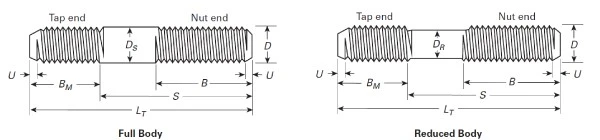
Tap End Stud Bolts are threaded rods with short thread length at one end, called the tap end for engagement with tapped machine hole, while the other end is longer for engagement with nut. Tap end studs are special stud bolts required for custom bolting requirement. Dimensions for tap end studs are defined in both metric and imperial sizes with unified national coarse pitch (UNC), fine pitch (UNF), fixed pitch (UN) and iso metric thread profile. These are produced across all material categories and astm specifications.
Our Tap End Stud Bolts are manufactured in nominal diameters ranging from 1/8"- 3" (M3 – M80). We offer tap end stud bolts in both USCS/Imperial and metric sizes.
Materials Used For Tap End Stud Bolts
Carbon Steel
Carbon steel is popular for stud bolts due to its strength, affordability, and availability. It is an iron-based alloy with a small carbon percentage, giving it excellent tensile strength and durability. Carbon steel studs are often used in applications where high strength and resistance to wear are required, such as heavy machinery, construction, and automotive industries. However, carbon steel is susceptible to corrosion, so that it may require additional coatings or treatments for protection in corrosive environments.
Stainless Steel
Stainless steel is an alloy of iron, chromium, and other elements with excellent corrosion resistance, strength, and durability. The chromium content in stainless steel forms a passive layer of chromium oxide on the surface, which protects the material from corrosion. A stainless steel stud would be commonly used in applications where corrosion resistance is a primary concern, such as chemical plants, marine environments, and food processing facilities.
Alloy Steel
Alloy steel has been modified by adding various elements, such as chromium, molybdenum, nickel, and others, to improve its mechanical properties. These alloying elements enhance the steel's strength, hardness, toughness, and resistance to wear, making alloy steel stud bolts suitable for high-stress applications and extreme conditions. Alloy steel stud bolts are often found in the oil and gas, aerospace, and power generation industries.
Superalloy
Superalloys are high-performance materials known for their excellent mechanical strength, resistance to thermal creep deformation, and ability to withstand high temperatures and harsh environments. These alloys typically combine nickel, cobalt, iron, and other elements, offering exceptional performance under extreme conditions. Superalloy stud bolts are often used in applications where conventional materials, such as aerospace, power generation, and high-temperature chemical processing industries, may not perform well. Superalloys ensure that stud bolts maintain their strength, stability, and resistance to corrosion even under the most demanding conditions.
Specifications
|
|
|||||||||
| Dimensions For Tap-End Studs (1.5D Engagement) | |||||||||
| D | BM | Umax = 2P | Bmin | ||||||
| Nominal Size Diameter | Tap-End Full Thread Length | Nut End Minimum Full Thread Length | |||||||
| Nominal | Min. | Max. | "UNC and NC-5 Threads" | UNF Threads | 8UN Threads | L ≤ 10 | 10 | L >16 | |
| 1⁄4 | 0.375 | 0.350 | 0.400 | 0.100 | 0.071 | … | 0.750 | 1.000 | 1.500 |
| 5⁄16 | 0.469 | 0.440 | 0.498 | 0.111 | 0.083 | … | 0.875 | 1.125 | 1.625 |
| 3⁄8 | 0.563 | 0.532 | 0.594 | 0.125 | 0.083 | … | 1.000 | 1.250 | 1.750 |
| 7⁄16 | 0.656 | 0.620 | 0.692 | 0.143 | 0.100 | … | 1.125 | 1.375 | 1.875 |
| 1⁄2 | 0.750 | 0.708 | 0.792 | 0.154 | 0.100 | … | 1.250 | 1.500 | 2.000 |
| 9⁄16 | 0.844 | 0.802 | 0.896 | 0.167 | 0.111 | … | 1.375 | 1.625 | 2.125 |
| 5⁄8 | 0.938 | 0.892 | 0.983 | 0.182 | 0.111 | … | 1.500 | 1.750 | 2.250 |
| 3⁄4 | 1.125 | 1.075 | 1.175 | 0.200 | 0.125 | … | 1.750 | 2.000 | 2.500 |
| 7⁄8 | 1.313 | 1.258 | 1.368 | 0.222 | 0.143 | … | 2.000 | 2.250 | 2.750 |
| 1 | 1.500 | 1.438 | 1.562 | 0.250 | 0.167 | … | 2.250 | 2.500 | 3.000 |
| 1-1⁄8 | 1.688 | 1.625 | 1.750 | 0.286 | 0.167 | 0.250 | 2.500 | 2.750 | 3.250 |
| 1-1⁄4 | 1.875 | 1.813 | 1.938 | 0.286 | 0.167 | 0.250 | 2.750 | 3.000 | 3.500 |
| 1-3⁄8 | 2.063 | 2.000 | 2.125 | 0.333 | 0.167 | 0.250 | 3.000 | 3.250 | 3.750 |
| 1-1⁄2 | 2.250 | 2.188 | 2.313 | 0.333 | 0.167 | 0.250 | 3.250 | 3.500 | 4.000 |
| 1-5⁄8 | 2.438 | 2.375 | 2.500 | … | … | 0.250 | 3.500 | 3.750 | 4.250 |
| 1-3⁄4 | 2.625 | 2.563 | 2.688 | 0.400 | … | 0.250 | 3.750 | 4.000 | 4.500 |
| 1-7⁄8 | 2.813 | 2.750 | 2.875 | … | … | 0.250 | 4.000 | 4.250 | 4.750 |
| 2 | 3.000 | 2.925 | 3.075 | 0.444 | … | 0.250 | 4.250 | 4.500 | 5.000 |
| 2-1⁄4 | 3.375 | 3.300 | 3.450 | 0.444 | … | 0.250 | 4.750 | 5.000 | 5.500 |
| 2-1⁄2 | 3.750 | 3.675 | 3.825 | 0.500 | … | 0.250 | 5.250 | 5.500 | 6.000 |
| 2-3⁄4 | 4.125 | 4.050 | 4.200 | 0.500 | … | 0.250 | 5.750 | 6.000 | 6.500 |
| 3 | 4.500 | 4.425 | 4.575 | 0.500 | … | 0.250 | … | 6.500 | 7.000 |
Tap End Stud Bolts Applications
Building Construction
This type of fastener is often used when constructing metal buildings, pipelines, bridges, and towers.
Industrial Use
In industrial environments, stud bolts can be used in engines or machines for vibration-resistant connections. They can also be used for attaching parts within machines or devices that require precise tightening control over long distances.
High Temperature Applications
Stud bolts are suitable for high temperature applications due to their ability to tolerate extreme heat without losing integrity.
Automobile and Marine Use
Stud bolts can also be found in many transportation applications, such as automobiles or boats. They are ideal for fixing motor vehicle components like exhaust systems, fuel lines, brakes, and suspension systems due to their secure connection capability.
How We Manufacture Tap End Stud Bolts
Step 1: Raw material Inspection & Cutting of Raw Material
The raw material is picked based on the application. Like all other stud bolt manufacturers, we also choose the material to be used and conduct a chemical and physical inspection of the round bar material. The round bar raw material is then selected as per the size, followed by cutting it for the required length. This process is followed in all bolt, nut, and stud manufacturing processes.
Step 2: Hot-forging Process
The hot forging process is applied for bolt and nut manufacturing. During the forging, the bolt head/nut is deformed by induction heating. Then, calculations are made to determine the required length, recrystallize the metal's temperature, and bend to the required shape and size.
Step 3: Annealing
In the next step, after forging, the material is annealed for uniformity and eased for machining. All three nut, bolt, and stud manufacturing include this process.
Step 4: Cleaning & Trimming
Surface finishing is the next step in the nut, bolt, and stud manufacturing process. Annealing and cleaning the nuts, bolts, and studs in a shot blasting machine makes the surface smooth and removes any scaling or burr. Next, the access material near the head is removed by trimming/drawing. This process is applicable only for nuts and bolts.
Step 5: Turning Process
The next step of bolt nut manufacturing is the turning process. First, the material is machined to the required dimensions, usually done by a CNC machine. This process is done to remove excess material and maintain a pitch diameter.
Step 6: Thread Rolling
This is a mechanical process where threads are cold-formed and is done with two dies. One is stationary, and the other is a moving die that actually exerts pressure on the bolts and studs.
Step 7: Heat Treatment
Heat treatment is done to make the bolts, nuts, and studs stronger. This process involves hardening materials in a gas carburizing furnace at a temperature of 850-900°C and then quenched in the cooling media. All the processes are recorded in data loggers.
Step 8: Phosphating
Phosphating is a chemical process of treating the surface. Operations are performed to alter the surface of the bolt, nut, or stud. Soluble metal-phosphate layers are formed on the job, enhancing the function and aesthetic appeal of the product.
Step 9: Packaging & Dispatch
After completing all the above steps, the products are sent for testing and inspection. First, they are thoroughly checked for their hardness levels, threading accuracy, strength, etc.; once they pass all these procedures, protective sleeves are inserted while packing to prevent damage to the thread and the packaging.
Why Choose Us
We have an advanced and comprehensive range of capabilities including engineering, R&D, prototyping, custom manufacturing, precision processing and testing. Our materials are sourced from the most reputable and exacting foundries in the world. We maintain a multi-million-dollar inventory of fasteners in our product warehouse, which enables us to select, package and expedite your tap end stud bolt order quickly.
We are proud to serve our distributors, EPCs, OEM and MRO customers worldwide.
Our tap end stud bolts meet applicable ASTM, ANSI, ASME, SAE, API, NAS, AN, MS, NACE, ISO, DIN, and KS standards.
Our markets include rail transportation, medical equipment, aerospace, ships, semiconductors, oil and gas, pharmaceuticals, petrochemicals & refining, food & beverages, and etc.
FAQs
Q: What is the difference between a tap end stud and a stud bolt?
Q: What is a stud bolt used for?
Q: Can studs have different threads on each end?
Q: What are the advantages of stud bolts?
Q: How are stud bolts measured?
Q: Where to use stud bolt?
Q: What are the properties of stud bolts?
Q: What is the difference between a stud and a stud bolt?
Q: What is the capacity of a stud bolt?
Q: How are stud bolts made?
Hot Tags: tap end stud bolts, China tap end stud bolts manufacturers, suppliers, factory, waterproof studs, wooden studs, elegant studs, antique studs, work studs, studs for kids