




What is that function of stud bolt? Why choose stud bolts?
 Feb 15, 2024|
 Stud, also known as stud or stud. Used to connect the fixed link function of machinery, the stud bolt has threads at both ends, and the screw in the middle is thick and thin. Generally used in mining machinery, bridges, automobiles, motorcycles, boiler steel structures, hanging towers, long-span steel structures and large buildings.
Basic introduction
Bolt refers to a screw with a larger diameter, or it may have no head, such as a stud. Generally, it is called "stud" instead of "stud". The most common form of stud is threaded at both ends and polished rod in the middle. The most typical use: anchor bolts, or places similar to anchor bolts, thick connections, when ordinary bolts can not be realized.
Specification marking
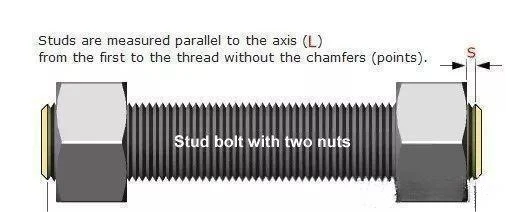
Equal-length stud with thread specification d=M12, nominal length L=80mm and performance grade 4.8 shall be completely marked as: GB901M12×80.
Main application
The main body of the machine is large equipment, and accessories need to be installed, such as sight glass, mechanical seal seat, reducer frame, etc. At this time, the stud bolt is used, one end of which is screwed into the main body, and the nut is attached to the other end after the attachment is installed. Because the attachment is often disassembled, the thread will be worn or damaged, and it will be very convenient to replace it with the stud bolt.
When the connector is very thick and the bolt length is very long, the stud bolt will be used.
It is used to connect thick plates and places where it is inconvenient to use hexagon bolts, such as concrete roof trusses, hanging pieces of monorail beams hanging from roof beams, etc.
Anti-loosening purpose
In practical work, vibration, change of external load and high temperature creep of materials will reduce the friction, and the positive pressure in the thread pair will disappear at a certain moment, and the friction will be zero, thus making the threaded connection loose. If it is repeatedly acted, the threaded connection will relax and fail. Therefore, it is necessary to prevent loosening, otherwise it will affect normal work and cause accidents.
Basic knowledge
Stud bolts are manufactured according to GB897-GB901 standard. The materials used are: Q235, 45#, 40Cr, 35CrMoA, Q345D. The specifications are: M3mm-M100mm, and the length can be customized according to users' needs.
High-strength stud bolts are made of 35#, 45#, 35CrMoA, 25Cr2MoV, 304, 316, 304L, 316L, 2H, 2HM, B7, B7M, B16, B8, 8, B8M and 8M, which are widely used in electric power, chemical industry, oil refining, valves and so on.
Representation method of stud bolts: generally, stud bolts are represented as M12×100GB901-88 (standard) 35#/35# (material) 8.8 /8 (modulation level), which means: diameter =12mm, length =100mmGB901-88 adopts the national standard (of course, industry standards can be adopted as required).
Standard for studs: GB900-1988
Brief introduction of stud bolt saves time and cost. The structure of all stud bolts does not need drilling, punching, threading, riveting, screwing and finishing, which continuously expands the application potential of structural design, with large current and small penetration. Therefore, it can be welded to a very thin plate. Stud welding workpieces must be welded from one side. Can be welded in all positions, and can be restrained on vertical partitions with the help of expanders. Because it is welded for a short time and there is little deformation after welding, it does not need to be trimmed. Because the welded structure does not need drilling, it will not cause leakage. The joint can achieve high strength, that is, the joint strength of stud welding is greater than the strength of stud itself.
How to install stud bolts The advantage of good economy over other welding methods lies in the welding power. For mass-produced workpieces, standard studs are of low cost. There are many types of equipment and welding guns, and the purchase cost of equipment is relatively low. According to the product, it can be made into multi-station automatic welding machine or high-precision gantry numerical control automatic welding machine. Stud welding has a high quality reproduction rate and a small rejection rate.However, in the application of stud welding, attention should be paid to other fusion welding, which has certain restrictions on the carbon content in steel. For structural steel studs, welding should be carried out according to the recommended combination of stud material and base material, otherwise there will be insolubility between stud and base material. The combination of stud materials and parent materials outside the recommended range should be tested to determine the weldability and the design requirements of anchor bolt products, and the possibility of relevant inspection and evaluation should be carried out.
Surface treatment
Stud bolts generally need surface treatment, and there are many kinds of surface treatment for bolts, such as electroplating, blackening, oxidation, phosphating and electroless zinc coating. However, electroplating fasteners occupy a large proportion in the actual use of fasteners. Especially in automobiles, tractors, household appliances, instrumentation, aerospace, communications and other industries and fields.However, for threaded fasteners, it is not only required to have a certain anti-corrosion ability, but also to ensure the interchangeability of threads, which can also be called screwing here. In order to meet the requirements of "anticorrosion" and "interchangeability" of threaded fasteners in use at the same time, it is very necessary to formulate special electroplating standards.
GB/T5267.1-2002[ electroplated layer of threaded fasteners] is one of the series of national standards "fastener surface treatment", which includes: GB/T5267.1-2002[ electroplated layer of fasteners]; GB/T5267.2-2002[ Non-electrolytic zinc sheet coating for fasteners] two standards. This standard is equivalent to the international standard ISO4042; 1999[ electroplated coating of threaded fasteners]. This standard replaces GB/T5267-1985[ electroplated coating of threaded fasteners].
Basic knowledge and maintenance
The production of stud bolts requires fixed fitting and machine processing. Of course, the processing procedure is relatively simple, and there are mainly the following procedures: firstly, it is necessary to pull out the material, which means to straighten the distorted material with a puller, and then the next procedure can be carried out. The next procedure is to cut the straightened long material into the length required by customers with a cutting machine, which completes the second procedure, and the third procedure is to roll the cut short material on a thread rolling machine. At this point, the common stud bolt is finished. Of course, if other requirements are needed, other processes are needed.
The commonly known bolt refers to a screw with a larger diameter. According to this statement, the diameter of the screw is much smaller than that of the bolt. Stud bolts have no heads, and some of them are also called studs. Both ends of the stud bolt are threaded, with no thread in the middle and a polished rod in the middle. Stud bolts are used on large equipment such as reducer frame. In practical application, the external load will vibrate and the friction will become smaller under the influence of temperature, and the threaded connection will relax and fail over time. Therefore, it is necessary to do a good job in the maintenance of stud bolts in normal times.Stud bolts or anchor bolts will have problems under the action of mechanical friction for a long time. When problems occur, remove the engine oil pan, carefully check the use of engine bearing shells, and check whether the gap between bearing shells is too large. If the gap is too large, replace it in time. When replacing the stud bolt, the connecting rod bolt should also be replaced. Some large equipment, such as nail making machine, should stop and check in time if it is found that the engine is not running stably or abnormal noise occurs during normal operation, so as to avoid more problems.
During each maintenance, it is necessary to inspect the newly-replaced stud bolts and other newly-replaced fittings. The inspection focuses on the head and guide parts of the stud bolts, and it is also necessary to strictly check whether there are cracks or dents in each part of the thread, and also check whether the tooth shape of the stud bolts has changed. Whether there is any abnormality in the pitch, if there is any abnormality, it can never be used again. The torque wrench should be used when installing the connecting rod cover. It must be tightened according to the specified standards, and the torque should not be too large or too small. It is also necessary to pay attention to the selection of studs and studs from supporting manufacturers.