




Guide to different bolt grades and bolt grade table
 Feb 07, 2024|
 Bolts, also known as fasteners, are parts used to tightly fix two objects together. They have various grades related to tensile strength. When choosing the exact bolt for the application, some things need to be considered, such as size, shape, length, thread type, material and grade. All these factors have been discussed quite extensively except achievement. However, the grade of bolts is a key factor that cannot be ignored. In this paper, we will introduce different grades of bolts, their classification methods and some uses in detail to help you understand which grade of bolts is most suitable for your project.
Chart of bolt grade and strength
Here, we provide a chart, which contains different grades of bolts and their mechanical properties. And the images in the chart can also help to show the grade of bolts, the identification marks on the bolt heads and the hardness and strength of ordinary grade bolts. Please note that the bolt head may also contain the manufacturer's identification mark, especially for high-strength bolts.
Table of bolt grades and strength-inch steel bolts
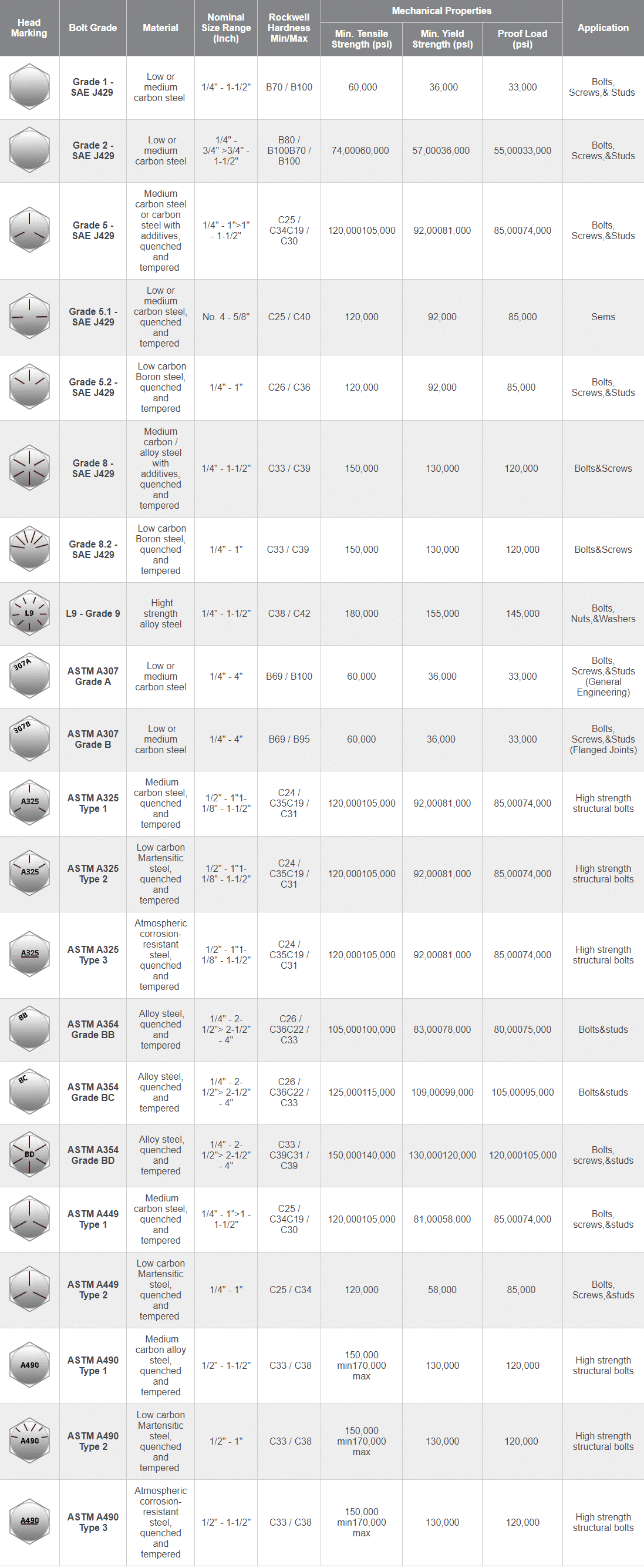
Chart of bolt grade and strength-metric steel bolts

Note: tensile strength: a measure of the maximum stress that a material can bear when it is stretched or pulled before failure. It is also called the ultimate power. Yield strength: a measure of stress when a material begins to deform plastically. It is also called elastic limit or yield point. It is determined by tensile test of material samples. ProofLoad: the specified test load applied to the component to ensure that it can withstand the expected maximum load. It is usually used to test components with static load, such as bolts and screws. 1MPa=1N/ mm2 = 145lb/in2.
What are bolt grades and bolt grade tables?
The grade of bolt refers to the strength and durability of bolt, which is usually determined by its manufacturing material. The bolt grade is printed on the bolt head as a mark, indicating the material type and strength grade of the bolt. For example, Grade 2 bolts are made of mild steel and are the most commonly used types of bolts in buildings. Grade 5 bolts are made of medium carbon steel with higher strength than Grade 2 bolts, while Grade 8 bolts are made of high carbon steel with the highest strength. The chart of bolt grade and strength summarizes the physical and mechanical properties of bolts of various grades. It includes information about bolt grade, tensile strength, material type and its common application.
Common bolt grades
The most common bolt grades are Grade 2, Grade 5, Grade 8 and alloy steel. Grade 2 bolts are made of mild steel and are the most common types of bolts. They are relatively strong, but not as strong as Grade 5 or Grade 8 bolts. Grade 5 bolts are made of medium carbon steel with a tensile strength of at least 120,000PSI. Grade 8 bolts are made of alloy steel with a tensile strength of at least 150,000PSI. Alloy steel bolts are very strong and used in demanding applications, such as automobiles and industrial machinery.
Three systems of bolt grades
There are three main bolt grades: SAE, ASTM and ISO. 1. The Society of Automotive Engineers (Society of Automotive Engineers) classifies bolts according to their strength, ranging from Grade 2 to Grade 8. Level 2 is the weakest and level 8 is the strongest. 2.ASTM (American Society for Materials and Testing) classifies bolts according to their chemical composition and physical properties, from Grade A to Grade F.. A level is the weakest and F level is the strongest. 3. The International Organization for Standardization (ISO) classifies bolts according to their material characteristics, ranging from 4.6 to 12.9. 4.6 is the weakest and 12.9 is the strongest.
Different bolt grades and their applications
ASTMA307
ASTMA307A is composed of medium and low strength carbon steel with a minimum strength of 60,000psi. They mainly appear in general non-critical applications, equivalent to SAEJ4292 bolts. ASTMA307B consists of medium-strength carbon steel with a strength of 60,000 to 100,000psi. They are often used for flanged joints in piping systems.
SAEJ429
SAEJ4292 Grade–The bolts of this grade are made of medium and low strength carbon steel, which is the lowest strength in SAEJ429 Grade, with a strength of 60,000 to 74,000psi. These bolts are used in non-critical applications and joints because they are cost-effective and will not be exposed to extreme stress or temperature. Saej Grade 4295–The bolts of this grade are made of medium-strength carbon steel or alloy steel, and the strength is between 105,000-120,000psi. Because of their excellent compression resistance, they are very popular in heavy machinery and military applications. Saej Grade 4298–The bolts of this grade are made of medium-strength carbon steel or alloy steel, and have the highest strength up to 150,000psi. Therefore, it is an ideal material grade suitable for the most severe, extreme and harsh conditions, such as aerospace engineering, heavy machinery, military and so on.
ISO898-1
ISO898-1 attribute level 8.8 provides moderate strength, which is equivalent to SAEJ4295 level. Applications of this level include military, heavy machinery and automobile industry. ISO898-1 performance grade 10.9 provides high strength, which is comparable to SAEJ429 grade 8. This grade is mainly used in military, heavy machinery and aerospace. ISO898-1 attribute level 12.9 provides some of the highest available strengths. These bolts are used to fix key applications such as engine parts and motor housings, and are the strongest bolts manufactured by Wilson-Garner.